Why contact center attrition, supervisor burnout, and low engagement so often trace back to a hiring decision made under pressure - and the metrics that can finally break the cycle.
Walk into most contact centers struggling with high attrition and low engagement, and you'll hear variations of the same explanation: the training wasn't thorough enough, the supervisors need to coach better, the onboarding was rushed, the team just needs more development. These are reasonable things to look at. They are rarely where the problem actually starts.
In many cases, the problem starts at the moment of hire - specifically, in what organizations choose to hire for.
When urgency drives recruiting, organizations reach for the most visible proxies of capability: prior contact center experience, technical familiarity, résumé history. These feel like safe bets. They are measurable, comparable, and easy to defend in a debrief. But they often predict very little about whether someone will thrive in your specific environment, under real operational pressure, day after day.
What does predict that? Behavior.
Hiring for experience when you should be hiring for behavior
Experience tells you what someone has done. Behavior tells you how they respond when things get hard - when a customer is escalating, when the queue is backed up, when a policy doesn't quite fit the situation in front of them, when it's the fourth hour of the shift and the energy is gone.
The behaviors that consistently predict long-term success in contact center roles aren't complicated, but they aren't on a résumé either:
- Resilience under pressure and emotional self-regulation
- Genuine customer orientation - caring about the outcome, not just completing the transaction
- Adaptability when processes, systems, or expectations shift
- Accountability - owning errors rather than deflecting them
- Comfort with ambiguity and the ability to make sound judgment calls
- Consistent follow-through, especially in repetitive or high-volume work
Prior contact center experience, counterintuitively, can sometimes work against you. Experienced candidates may arrive with deeply embedded habits, shortcuts, and attitudes shaped by a very different culture or set of expectations. They've "done this before" - but not necessarily in a way that transfers cleanly into your environment.
Experience tells you what someone has done. Behavior tells you how they'll respond when it gets hard. Only one of those things predicts long-term success.
None of this means experience is irrelevant. It means experience should never be the primary filter - and in too many organizations operating under staffing pressure, it is exactly that.
The seat-filling mindset and why it compounds the problem
Urgency is the enemy of selection quality. When a contact center is understaffed, the pressure to fill seats quickly is real and legitimate - operations can't run on vacancies. But urgency has a predictable effect on hiring decisions: it compresses screening, shortens interviews, raises the threshold for "good enough," and shifts the question from "is this person likely to succeed here?" to "can this person start Monday?"
The result is a cycle that many contact center leaders recognize but struggle to escape:
- Seats are filled quickly with candidates who clear a minimum bar
- Training is rushed because operations still needs coverage
- Employees reach production before they are genuinely ready
- Supervisors absorb the gap, spending their time managing struggle rather than developing performance
- Engagement drops, confidence erodes, and early attrition climbs
- Vacancies reopen - and the cycle restarts
Each loop through this cycle is expensive. Each loop makes the next one more likely. And at no point does the organization pause long enough to ask whether the hiring criteria themselves are the source of the problem.
This is not a training failure. It is not a management failure. It is a selection failure that training and management are being asked to compensate for - and they cannot compensate for it indefinitely.
What best-practice recruiting actually looks like
Organizations that consistently build strong, stable contact center workforces approach recruiting as something fundamentally different from vacancy-filling. They treat it as a continuous improvement system - one designed to get smarter with every hiring cycle by asking questions that most organizations never think to ask:
- Which hires succeed here? Which struggle? What's the difference between them?
- Which hires are still here at 6 months? At 12? What predicted their retention?
- Which recruiting sources produce the strongest long-term outcomes?
- What behaviors and attributes consistently correlate with high performance in our environment?
- What are we seeing in early engagement data that signals risk before attrition happens?
- Which onboarding cohorts outperform others - and what was different about their experience?
Answering those questions requires connecting data that most organizations keep siloed. It requires recruiting to operate not as a standalone HR function but as a partner to operations, workforce management, quality, training, and employee engagement. The intelligence flows in both directions: recruiting informs those functions, and those functions continuously refine recruiting.
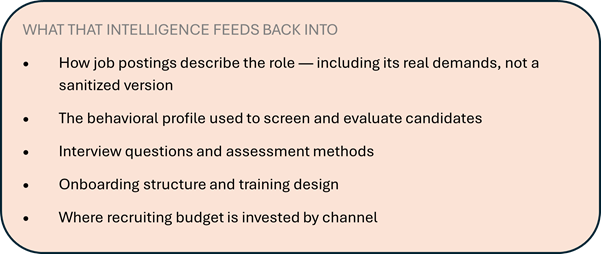
The metrics that make the feedback loop work
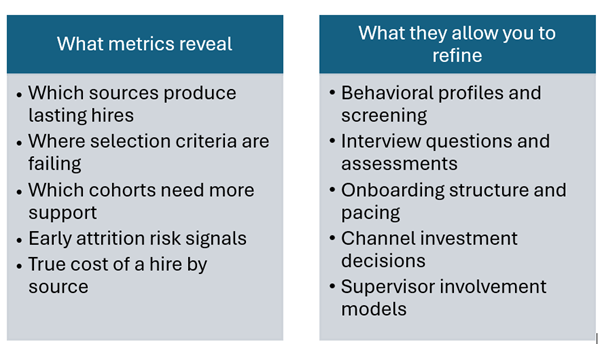
A continuous improvement system requires data. Specifically, it requires metrics tracked across the full employee lifecycle - not just at the point of hire - and cross-referenced in ways that reveal patterns no single metric can show on its own.
True cost per hire. Most organizations measure recruiting costs narrowly: advertising spend, recruiter time, maybe onboarding materials. True cost per hire includes HR processing, interviewing, equipment, training time, OJT support, supervisor coaching hours, and attrition replacement costs. When analyzed alongside retention and performance outcomes, this metric reframes the entire conversation. The source that fills vacancies fastest and cheapest often becomes the most expensive source once downstream costs are counted. The goal is not hiring faster - it is hiring effectively.
Training completion rates - disaggregated. Completion rates are a starting point, not a conclusion. The questions worth asking are: Who completes training and who struggles? Do patterns emerge by recruiting source, cohort, or onboarding structure? Are some groups consistently requiring more support - and if so, why? Completion data becomes strategically valuable only when it is broken apart and cross-referenced with what happens afterward.
Retention by source, cohort, and supervisor. This is one of the most underused and revealing metrics available. Tracking long-term retention by recruiting source, hiring cohort, onboarding group, and supervisor assignment surfaces patterns that aggregate data obscures. A source that generates fast hires may also generate significantly higher first-year attrition. A cohort that consistently outperforms others may reveal something important about trainer effectiveness, onboarding quality, or selection criteria. This type of analysis moves organizations from anecdote to evidence.
Early engagement signals. Low engagement during the first 90 to 180 days reliably predicts future attrition - which means it also represents an intervention window, if organizations are paying attention. Short pulse surveys and stay interviews at 30, 60, 90, and 180 days can surface warning signs long before an employee gives notice. The questions that matter most center on preparedness, support, alignment between what was promised during recruiting and what the role actually requires, and whether the employee genuinely believes they can succeed.
Breaking the cycle
The contact centers that escape the attrition cycle share a common characteristic: they stopped treating recruiting as a response to vacancies and started treating it as a strategic function with a feedback loop. They defined - based on evidence, not assumption - the behavioral profile that predicts success in their specific environment. They screened for that profile deliberately, even when it meant slowing down. And they used connected metrics to continuously test whether their criteria were working and refine them when they weren't.
That is not a complicated system. But it requires something many organizations in a chronic staffing crunch struggle to find: the discipline to invest in selection quality even when the pressure to fill seats is loudest. Because the pressure to fill seats never goes away when selection quality is low. It just keeps cycling.
Supervisors who spend their days managing underperformance on the production floor, engagement scores that won't move, attrition that rebounds every quarter - these are not inevitabilities of the contact center environment. They are, in many cases, the downstream cost of a hiring decision made under pressure, optimized for speed, and measured by the wrong things.
The question isn't how quickly you can fill a seat. It's whether the person in that seat was ever likely to succeed - and whether you have the data to know the difference.
Building a workforce that is stable, engaged, and capable of delivering a consistent customer experience starts with selecting the right people. Measuring whether you're doing that - and getting smarter about it over time - is how sustainable workforce performance is built.
Not in the training room. Not on the production floor. At the moment of hire.